
Torsion springs, explained over the fence
If you have ever strained a fence, you already understand a garage door spring. Same physics, same respect required. Here is the whole system in the language this valley already speaks.
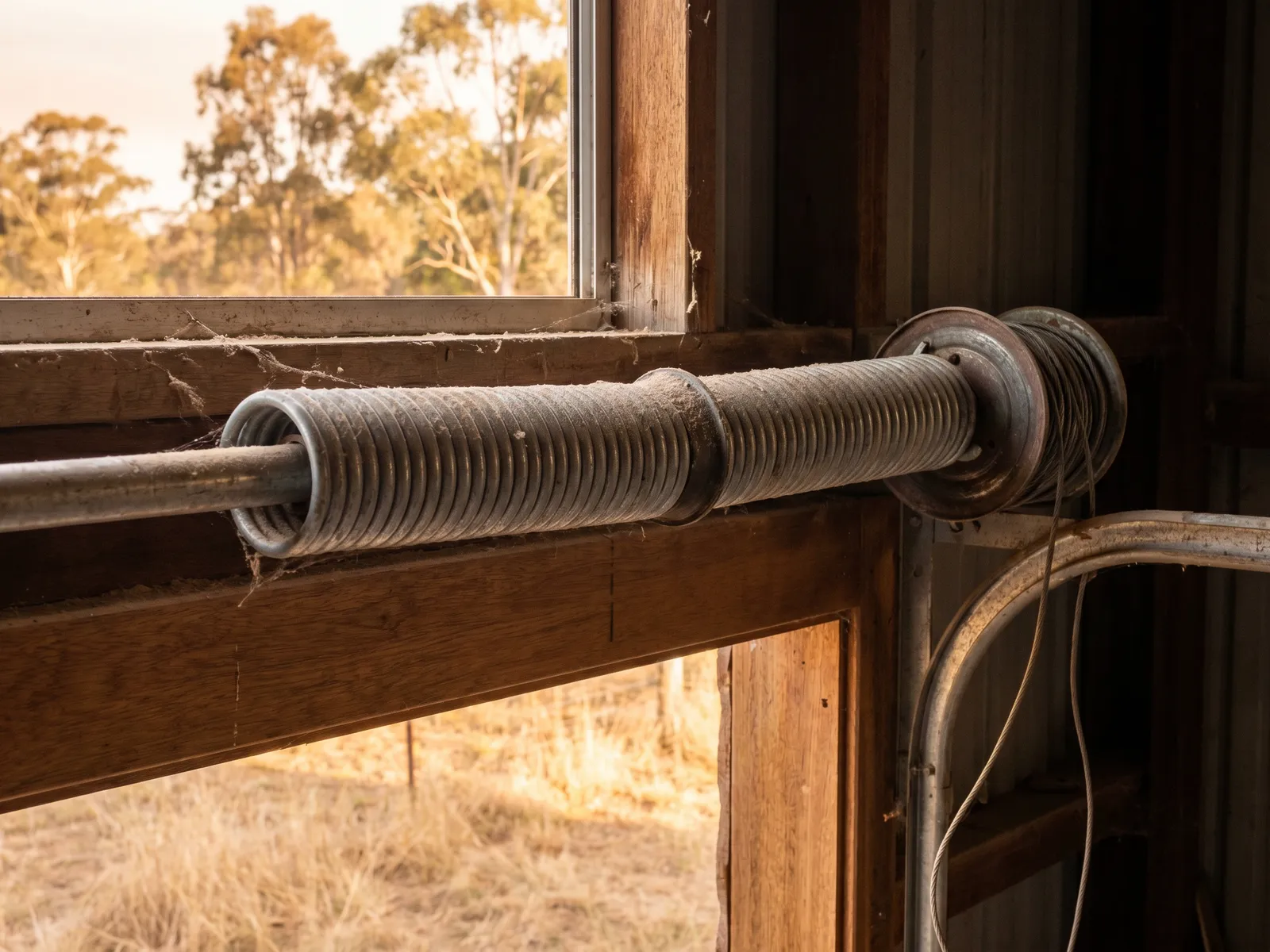
The strainer analogy, properly told
A strained fence works because energy is stored in stretched high-tensile wire, and every fencer knows the two rules that follow: the wire does the holding, and you never stand where it will go if it lets go. A garage door torsion system is the same idea turned sideways. Above the door sits a steel shaft; wound onto it is a spring, twisted, not stretched, through several full turns when the door is down. That twist stores the energy that carries the door's weight.
Cables run from the bottom corners of the door up to drums on each end of the shaft. As the spring unwinds it turns the shaft, the drums wind the cables in, and the door rises almost weightless. The opener, for all its buttons, only steers; the spring does the lifting. A big double door can weigh well over a hundred kilograms, and every kilogram of it is held in that wound steel all day, every day.
The opener is the farmhand. The spring is the horse.
Why springs snap, and when
Steel that is repeatedly wound and unwound fatigues, exactly like fence wire bent back and forth at the same point. A standard torsion spring is rated at around 10,000 cycles, one cycle being one open and close. The arithmetic is worth doing once for your own doors:
| Duty | Cycles/day | Years to 10,000 |
|---|---|---|
| Quiet door | 2 | ~13.7 |
| Family door | 4 | ~6.8 |
| Busy household | 6 | ~4.6 |
| Working shed | 10 | ~2.7 |
| Site or forklift door | 20 | ~1.4 |
This is why the busiest door on a property is rarely the oldest one when it fails, and why we ask about duty, not just age. More on that thinking in cycle count beats age. When a spring reaches its fatigue life it does not sag politely; it fractures, all its remaining twist releases through the break at once, and the whole street hears the bang.
After the bang: what is actually going on above your door
A snapped spring is easy to spot: sight along the coils and there will be a clean gap, two ends that no longer meet. The door is now dead weight. The opener will strain and give up, and hand-lifting is a genuine two-person dead lift with nothing to hold the door if a grip slips. What is less obvious is that the system around the break, the second spring on a two-spring door, the cables, the drums and the brackets they anchor to, can still be holding real tension.
The rule, one more time: nothing on the spring assembly gets unbolted, "just loosened" or helped with a screwdriver. Fencers do not undo a strainer under load; the same instinct applies here, except the strainer is above your head. Winding and unwinding torsion springs safely takes purpose-made bars, the right stance and practice. This is the one job in the trade we will always say do-not-DIY about, without apology.
Good questions people actually ask
There are two springs on my door. Do both get replaced?
Usually, yes, and it is worth understanding why rather than taking it on faith. Two springs on one shaft have lived identical lives, every cycle one has done, the other has done. When one fractures at its fatigue life, its twin is at the same point in its own. Replacing them as a pair is not upselling; replacing one is booking the second bang in advance. If a technician anywhere recommends otherwise for a specific reason, ask them to show you the reason on the door.
My door has springs along the tracks, not over the door
Those are extension springs, common on older tilt and sectional doors. They stretch rather than twist, and when they fail they can recoil like, well, snapped fence wire. Good practice is a safety cable run through each spring so a broken one is caught instead of launched, and on major work they are often upgraded to a torsion setup. If your extension springs have no safety cables, that is worth a service visit on its own.
Can a spring be "re-tensioned" instead of replaced?
A door that has drifted heavy can sometimes be rebalanced within the spring's remaining life, that is a normal service adjustment. But tension is not the same as fatigue: winding more turns into a spring near its cycle rating does not give it life back. An honest assessment tells you which side of that line your spring is on, and we will show you the maths on site.
Heard the bang this morning? Book the repair and leave the hardware alone. Curious how the rest of the system earns its keep? The full won't-open diagnostic covers the other five symptoms.
