
Cycle count beats age
Ask when a door was installed and you learn almost nothing. Ask how many times a day it opens and you can nearly write the service schedule from the answer. Here is the arithmetic, and what this valley's weather adds to it.
The duty arithmetic
Almost every wearing part in a door system, springs, cables, rollers, hinges, the opener's drive, wears per cycle, one open and close. A standard torsion spring is rated around 10,000 cycles. Run the numbers across a property and the results usually surprise the owner:
| Door | Cycles/day | Cycles/year | Years to 10,000 |
|---|---|---|---|
| Hay shed, opened weekly | 0.4 | ~150 | 65+ |
| House double, family use | 4 | ~1,450 | ~6.8 |
| Machinery shed in season | 10 | ~3,650 | ~2.7 |
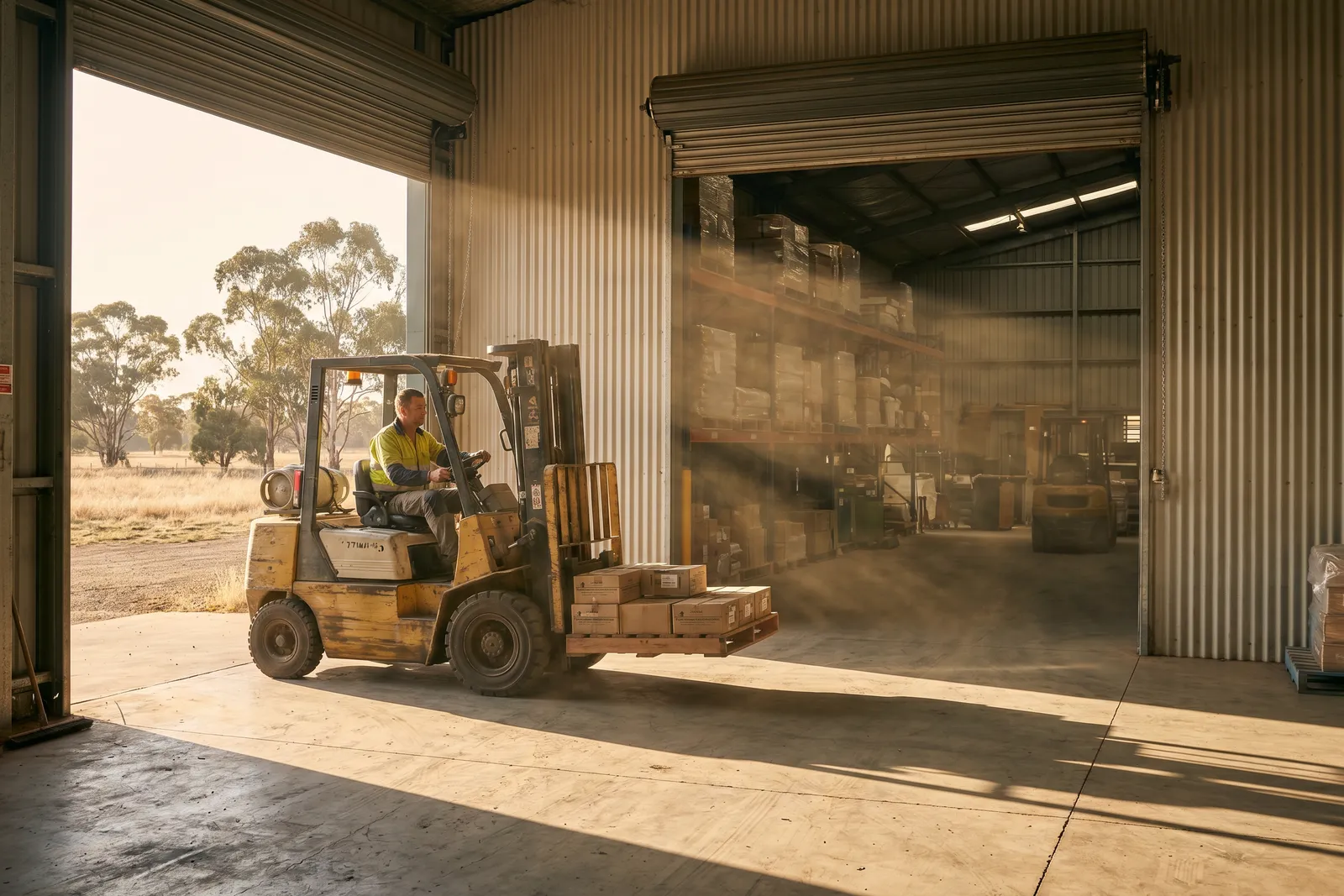
| Despatch shutter, forklift traffic | 20 | ~7,300 | ~1.4 |
Two doors bought the same week can be a decade apart in real wear. That is why "the door is only four years old" comforts nobody who has done this maths, and why the busiest door on the place should be serviced on its duty, not its birthday. The Door Muster runs this arithmetic across every door you tally.
What the dry country adds
The Hunter's inland side is genuinely dry, semi-arid by climate classification, with summers that sit around 29 and 30 degrees for weeks. On doors, that climate runs a predictable wear sequence:
- Seals first. Dry heat perishes rubber years before steel shows anything. Daylight or dust at the bottom edge is chapter one.
- Dust second. Once the seal admits it, fine dust off gravel drives and paddocks packs into tracks, rollers and bearings and grinds quietly. On west-facing doors the westerlies deliver it for free.
- Binding third. Dust plus dry lubricant means the door starts working against friction, the opener strains, the balance drifts, and the wear rate on everything else steps up.
Nothing in that sequence is dramatic until the end of it. Servicing exists to interrupt it at step one, where the fix is a seal and a clean, not a parts list.
What a proper service actually covers
- Spring tension checked against the door's real weight, and balance corrected within the spring's remaining life.
- Tracks and guides cleared, rollers, hinges and bearings inspected and lubricated with the right product, dust country punishes the wrong one.
- Cables and drums inspected for fray and wear seats.
- Opener force and travel limits set, and the safety functions proven: beams, auto-reverse, manual release.
- Seals and weather strips checked, the early-warning system for everything above.
- A written record of what was found, so next service has a baseline and the repair-or-replace call is made on evidence.
Know a door that is noisy, heavy or leaking daylight? That is the sequence talking. Book a service, or tally the property first with the Door Muster.
