
Choosing a door for a machinery shed
The brochure will sell you a colour. The shed needs a spec. Here are the numbers that actually decide a machinery-shed door, in the order they decide it.
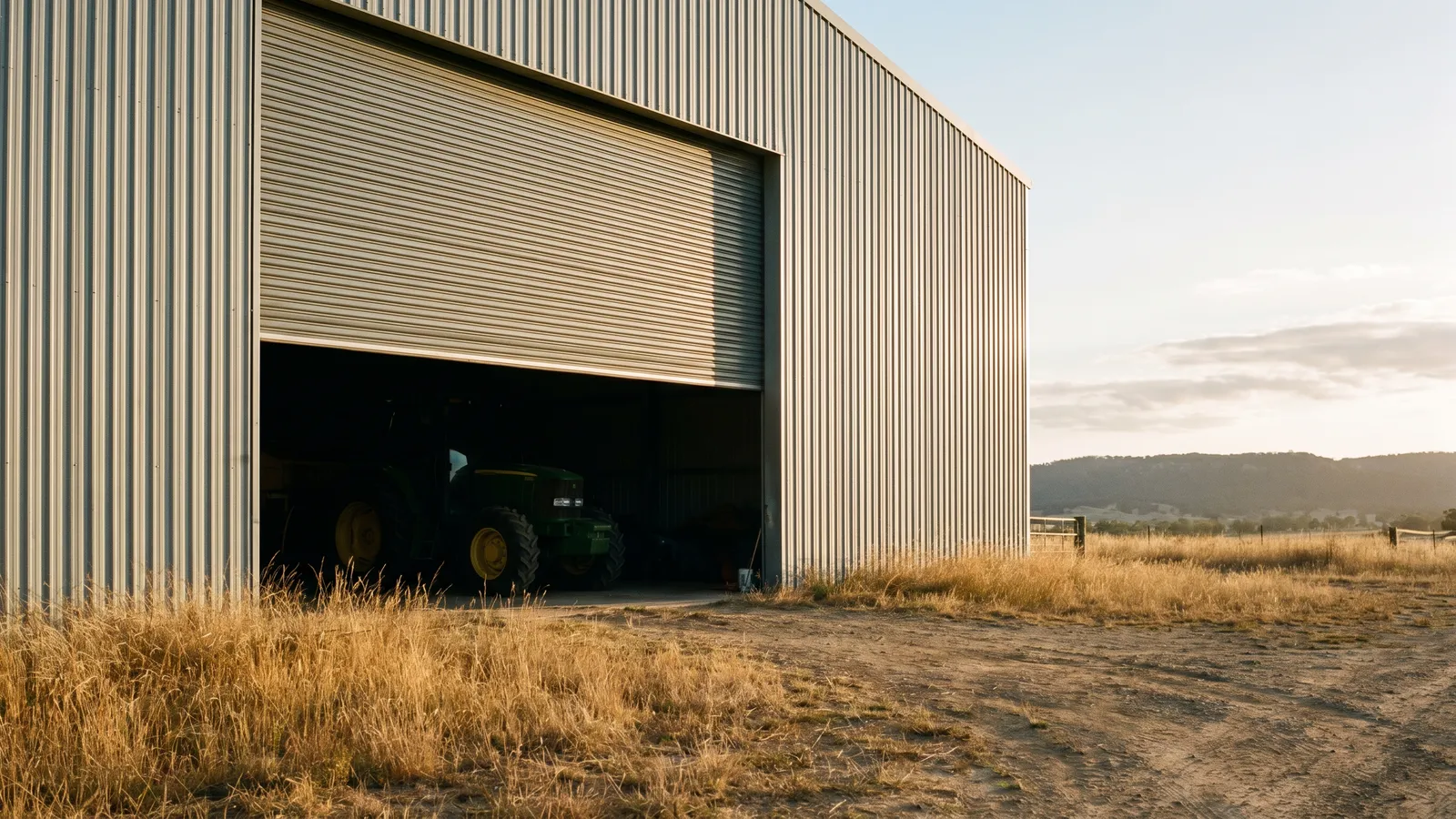
First: what has to pass through the hole
Every shed door spec starts at the same place: the tallest, widest thing that will ever pass under it, plus clearance you will thank yourself for. Measure the machine, not your memory of it; a cab with a beacon, a raised tipper, mirrors on a truck, the header with the comb on. The classic mistake in this valley is a door sized for the tractor you had, not the one you are getting.
| What is passing through | Typical height | Sensible opening |
|---|---|---|
| Ute, side-by-side, small tractor | to 2.2 m | 2.7 m |
| Mid tractor with cab or loader | 2.8 to 3.2 m | 3.6 m |
| Truck, header, tall implement | 3.4 to 4.3 m | 4.5 m+ |
Second: the span, and what width does to the engineering
Width is where a shed door stops being a big garage door. As the span grows, the curtain gets heavier, the wind load on its face multiplies, and the drum and spring sizing step up with it. Past roughly 5 metres you are firmly in wide-span territory: heavier-gauge curtain, wind considerations as standard, and sometimes the honest answer that two doors serve the bay better than one huge one, especially where machinery only ever uses one side.
Third: headroom and side room, the quiet deal-breakers
A roller door needs room above the opening for the rolled curtain, more than most people expect on a big door, and clear wall beside the opening for its brackets and guides. A portal-frame shed usually has both; a shed with trusses right at lintel height or a mezzanine above the door may not, and that is what pushes a job toward a different door type or a hood outside the wall. The four numbers we measure on every quote are on the shed doors page; the short version is span, height, headroom, side room, in that order.
Roller or sectional, at shed widths
| At shed scale | Roller curtain | Sectional panels |
|---|---|---|
| Wide spans | The default choice, engineered wide as standard | Possible, needs ceiling track depth the shed may not have |
| Headroom use | Rolls into a drum above the opening | Runs back under the roof on tracks |
| Dust tolerance | Good; guides need periodic clearing | More rollers and hinges to keep clean |
| Insulation | Limited on plain curtains | Better, if the shed is conditioned or a workshop |
| Repairs out here | Curtain and guide work, well understood | Panel-by-panel, more parts to carry |
For most machinery sheds in this valley the roller curtain wins on span, headroom and simplicity. The sectional case gets stronger when the shed doubles as a workshop you heat or cool.
Wind: the load nobody sees until it arrives
A 5 metre by 4 metre door is twenty square metres of sail, and the westerlies that run this valley will find it. Wind loading on structures, doors included, is the territory of the Australian wind actions standard, AS/NZS 1170.2; what matters practically is that wide doors on exposed faces should be specced with wind in mind, wind-locked guides and curtain bracing where the exposure earns it. We will not quote a wind rating off a brochure; exposure is read at the shed, on the measure, looking at what the door actually faces.
The duty question
How many times a day will this door cycle? A hay shed opened weekly and a workshop door cycling twenty times a day can be the same size and need very different springs, and the difference decides how long the door lasts. A standard spring is rated around 10,000 cycles; high-cycle springs exist for doors that work for a living. Say the duty honestly at quote time and the door gets built for it. The full arithmetic is in the springs guide.
Motorising, and the wiring rule
Big shed doors are exactly where a motor stops being a luxury: nobody hand-hauls a wide curtain twice a day for long. Roller doors this size usually take a tubular or side-mount motor, remotes reach further than you think across a yard, and a battery backup means a blackout does not lock the machinery in. One rule does not bend: mains wiring for a motor is licensed electrical work in NSW (the licensing rules are public), so a licensed electrician does that part, arranged as part of the job.
Building or replacing? Book a measure and have the machine list handy. And if the shed is one of several doors on the place, the Door Muster tallies the lot in one go.
References
- AS/NZS 60335.2.95 (Standards Australia): the safety standard for automatic garage door openers, relevant to any motorised shed door.
- NSW Government: electrical work licensing: the licensing framework that makes opener mains wiring an electrician's job.
